
How to deal with the aluminum extrusion ?
Committed to the development of high‑quality, high‑precision, large‑cross‑section, thin‑wall profiles. We own 12 extrusion production lines with press capacity ranging from 600T to 12000T. The linear weight ranges from 0.05 kg/m to 100 kg/m, and the circumscribed circle diameter ranges from 5 mm to 700 mm. The tolerance for extra‑large cross‑sections meets high‑precision‑grade standards.
High‑purity aluminum ingots and alloying elements are fed into the melting furnace. Magnesium and silicon are added for 6063‑T5; custom‑tuned magnesium‑silicon ratios are adopted for 6005A‑T5, while manganese is incorporated into 6082 to meet the high‑strength requirements for rails.Raw materials are melted at 720‑760 ℃, followed by degassing and slag‑removal procedures to eliminate hydrogen and impurities and prevent pores and pinholes on finished profiles.After standing, molten aluminum is cast into solid cylindrical billets, which then undergo homogenization annealing. Long‑duration high‑temperature heating homogenizes alloy composition, facilitates smooth extrusion and minimizes profile distortion and spring‑back.Key Note: The homogenization standard for 6005A‑T5 overhead‑track billets is extremely strict. Inadequate homogenization commonly causes cross‑section collapse and torsional deformation during subsequent CNC roll‑bending.
Billets are sawn into fixed‑length blanks according to profile cross‑section and extrusion length.Billet temperature is precisely controlled between 450‑520 ℃ inside the heating furnace.
Insufficient temperature: poor metal flowability, accelerated die wear and blemishes on the profile surface
Excessive temperature: coarse aluminum grains, lowered material hardness and bending‑induced cracks
Flat dies and porthole dies for hollow profiles are pre‑heated to 420‑480 ℃. This avoids thermal shock and surface cracks when hot billets make contact with cold moulds.
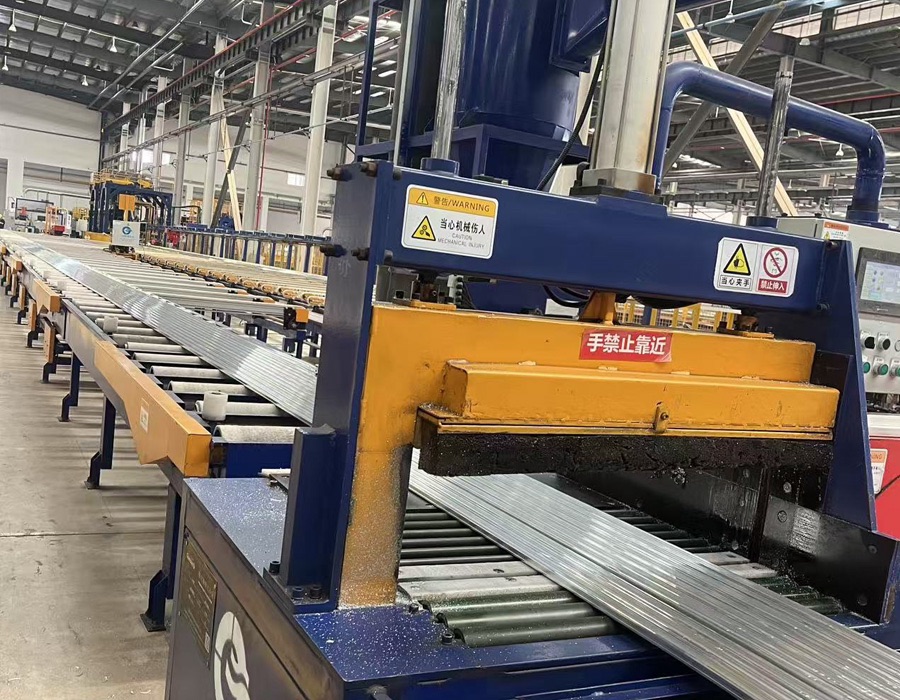
Solid profiles adopt flat dies
Hollow‑cavity rail profiles adopt porthole dies: aluminum flow is split by the bridge and then welded together to form hollow chambers.
Air quenching (6063‑T5): Powerful air flow rapidly cools extruded workpieces to lock alloy crystal structures and achieve T5 hardness.
Water‑mist quenching (high‑strength 6005A‑T5 / 6082): Rapid water‑spray cooling yields superior hardness for load‑bearing rails.
T5 air‑quenched profiles: 3‑4‑hour heat preservation at 170‑180 ℃
T6 quenched profiles: Extended heat preservation at 165 ℃
Copyright © 2025 Shanghai Dunpin Aluminum Technology Co., Ltd.